Music for the Dolphins and Whales of Japan
Towards a new connection
with dolphins and whales


Introducing the crowdfunding message for 2025
To all who love the ocean, dolphins, and whales,
When I asked myself where my deepest joy truly lives,
the answer was clear —
it is in the ocean, together with dolphins and whales.
Without them, I would not be who I am today.
In the ocean, the dolphins guided me
through a journey of transformation in my consciousness.
I began to wonder:
How can I express the love and joy
I received from them to the world?
Where should I be, and what should I do?
This question has always lived in the very center of my heart.
And when I met a dolphin named Kai,
a profound feeling arose from the deepest place within my heart —
the wish to create a dolphin rehabilitation center here in Japan,
the project I would like to share with you today.
The dolphin I love dearly, Kai,
is someone I met three years ago
at an interactive dolphin facility in Taiji.


In 2022, I began Project ANIMA.
As one part of its activities, from autumn through spring,
I travel to Taiji, where dolphin drive hunts take place.
There, we hold prayer ceremonies
for the dolphins and small whales who lose their lives.
The dolphins who are not killed in the drive hunts
are captured and sold to aquariums in Japan and other parts of Asia.
Most of the dolphins living in Japanese aquariums
were taken through these hunts —
and Kai is one of them.
“Human” and “animal.”
In Japanese, the word for animal is written
with characters that mean “moving thing.”
Yet they, just like us,
have families, friends, and a homeland.
They are living beings —
never “things.”


Kai means "sea" in both Japanese and Hawaiian.
Kai's hometown is the sea,
a child who came from the wide, free sea...
I want dolphins like Kai to come back
Like the dolphins I met in the oceans all over the world
Living like a dolphin, expressing joy and love
When I imagine such a future
I feel excitement rising from deep within my heart.
I wanted to make that happen


What is a “rehabilitation center”?
Overseas, rehabilitation centers are often called sanctuaries.
They are places that receive dolphins
who were captured and have lived in aquariums or other facilities.
Here, they retire from performances and shows.
The purpose of a sanctuary is to provide a space
where dolphins can remember that they are dolphins
and live in a way that is natural to them.
These spaces are connected to the ocean
— their true homeland —and offer a far wider,
more natural environment than the concrete pools of aquariums.
What does it mean for
a dolphin to live “like a dolphin”?
For example, imagine the difference between
a chlorinated pool surrounded by concrete
and the living waters of the sea, in a vast open space.
What kinds of changes might arise for them?
Dolphins use sonar (echolocation) — like a “third eye” —
to understand their surroundings and find food.
It is an essential ability for surviving in the vast ocean.
In concrete pools, sonar signals bounce back in unnatural ways,
and dolphins gradually stop using this ability.
By spending time in the ocean,
they can begin to remember how to use sonar again
and even learn to catch live fish on their own.
The concept of a “sanctuary” is widely recognized overseas.
There are already dolphins who, after several years of rehabilitation,
have been able to return to the sea.
In Japan, due to legal considerations,
it is still unclear whether releasing dolphins back into the ocean
is currently possible.
Yet my deepest wish, above all else,
is simply that dolphins may live as freely and as fully as possible —
spending the rest of their lives with happiness and dignity,
being truly themselves.

The first step in bringing this project into form
was simply deciding on a place —
asking the question:
Where in Japan could a rehabilitation center truly be created?
Over several years, with the support of friends across Japan,
I felt the potential of many different locations.
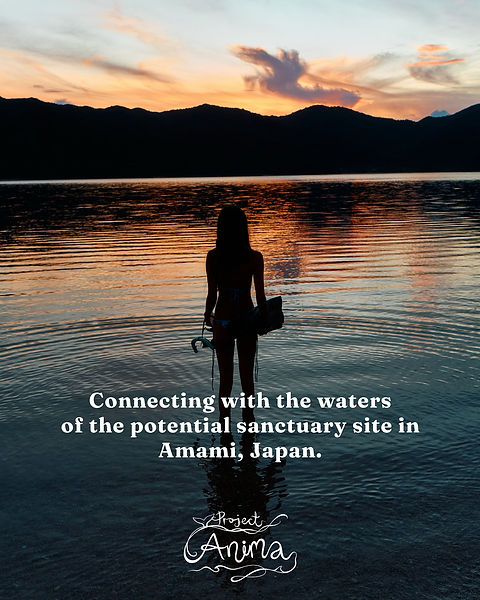
Among them, a five-mile bay on Kakeroma Island
began to feel as though it might be perfect.
I know that making this rehabilitation center a reality
will likely be a long journey.
It will require gaining approval from the prefectural government,
finding financial sponsors,
and building cooperative relationships with aquariums,
veterinarians,and dolphin trainers in Japan.
Yet before anything else,
I felt it was most important to first introduce this project
to the people of Amami Oshima and Kakeroma Island.
Together with those who call Amami their homeland,
I hope to explore how this project can move forward
in a way that feels comfortable, respectful, and harmonious.
I truly wish to receive your opinions and feedback,
and to let dialogue guide the development of this project.
And I would love to connect with those who feel called
to participate in or support this vision.


Finally, the ideal form of this project
For people in various positions involved with dolphins, such as aquariums and drive fisheries
Rather than denying or opposing
The dolphins taught me
We want to cherish choices and harmony that come from joy.
Rather than expecting and denying change outside of yourself,
I want to do what I can to help.
Building trust and harmony through dialogue with the aquarium industry
For the entertainment of humans for years
What should we do with the dolphins that have existed for so long?
Both people and dolphins feel comfortable
Can I let you retire?
I would like to think about it.
This project reminds us of Japan's connection with dolphins and whales.
Connected to everything and respecting everything
Remembering the nature of Japanese animism
I hope it will be a trigger
If you share this sentiment,
Please do so through crowdfunding.
Join us in this vision for the future
For more information on Project ANIMA